

Flip Off-the-Plan Property with confidence in Thailand by understanding the legal, financial, and strategic realities of reselling pre-construction units. This guide breaks down what flipping really means, how assignment rights work, developer policies you must know, and when it makes sense to exit before completion. Ideal for investors, expats, and anyone looking to stay flexible in a fast-moving real estate market.
Table of Contents
What buyers should know about reselling pre-construction units — legally, financially, and strategically.
Plans change. Markets shift. And sometimes, that off-the-plan unit you locked in a year ago isn’t quite the right move today.
Whether you’re facing a change in life circumstances or simply seeing a sharp rise in demand, the idea of flipping your pre-construction property before it’s even finished can start to look very attractive. In some cases, it’s a necessity. In others, it’s a strategic exit — especially when a unit gains value during the build phase.
But the rules of the game aren’t always obvious.
Can you legally resell your unit before handover? Will the developer allow it? Are there fees involved? And most importantly — is it even a smart move?
In this article, we’ll break down:
- What “flipping” off-the-plan actually means
- What Thai developers and contracts do (and don’t) allow
- Legal, financial, and practical constraints
- When it makes sense — and when it doesn’t
This is for buyers who want options, and for investors who want clarity. Let’s get into it.
What Does “Flipping” Off-the-Plan Mean?
In the real estate world, flipping usually means buying a property, holding it for a short time, and then selling it for profit. When it comes to off-the-plan property, flipping means something more specific:
You’ve signed the contract, made some staged payments, and the unit is still under construction — but you want to resell your contract before completion and handover.
In most cases, this means assigning your purchase agreement to a new buyer, who then takes over the remaining payment milestones and eventually receives the title once the project is complete.
Why do people do this?
There are a few common motivations:
- 📉 Life or cash flow changes: The buyer’s situation has shifted. Maybe they need liquidity, are relocating, or simply no longer need the unit.
- 📈 Price growth during construction: If the market is hot, some buyers see an opportunity to exit early and lock in gains — especially if they bought at pre-launch prices.
- 🛑 Personal use no longer fits: The original intent might’ve been to live there or retire later — but plans change.
Quick Note: This Isn’t Post-Handover Resale
What we’re talking about here is reselling before the property is complete and titled. That’s different from buying, receiving the property, and then flipping it right after transfer — which brings other tax and legal considerations (and probably deserves its own article).
Is It Legal to Resell Before Completion in Thailand?
The short answer is yes — but it depends on your contract.
There’s no law in Thailand that outright prevents you from reselling an off-the-plan unit before it’s finished. But that doesn’t mean your developer will let you do it freely.
Most off-the-plan purchases are governed by a Sales and Purchase Agreement (SPA) or a Reservation + Main Contract combo, and the right to resell during construction usually comes down to one clause:
➡️ Assignment rights — also labeled as “transfer of rights,” “contract reassignment,” or similar.
Here’s how it usually plays out:
- Some developers encourage it — especially if you bought early and helped de-risk the project. They may view it as added sales momentum.
- Others tightly restrict resale until the unit is nearly complete, or unless specific conditions are met.
- A few don’t allow it at all — at least not without jumping through legal hoops or paying a hefty fee.
You’ll want to review your contract and look for language like:
- “The purchaser may assign this agreement with written approval…”
- “Transfer of rights is subject to administrative fee…”
- “Assignment is not permitted prior to completion”
And if the contract is vague? You’ll need to clarify directly with the developer — ideally before trying to line up a new buyer.
Developer Policies: Assignment & Transfer Fees
Even if flipping is allowed, it’s rarely free. Most developers in Thailand will charge an assignment fee if you want to resell your off-the-plan unit before handover. Think of it as a contract transfer or admin fee — and it can range quite a bit depending on the project.
Typical fees:
- Flat fee: ฿50,000–฿200,000
- Percentage: 1–2% of the contract value
- Some also require the new buyer to pay any unpaid installment immediately — so your timeline matters.
These fees aren’t designed to punish — they’re about controlling liquidity and protecting the developer’s pricing strategy.
Assignment Timing Varies by Developer
Not all developers take the same stance. Here’s how it typically breaks down:
- ✅ Flexible developers (like some smaller boutique firms or those selling aggressively) may allow flipping as early as the first payment milestone — especially if your resale price aligns with their current price list.
- ⚠️ Established premium developers (like Botanica or Sansiri) tend to allow assignment, but only closer to completion, once the project is nearly sold out or the building is nearing handover. They don’t want speculative resale undermining pricing.
- ⛔ More restrictive developers may not allow assignment at all unless special approval is granted — especially if they offer financing or guaranteed rental return programs.
Real Example:
In projects like Dominion Rawai, the developer clearly states that resale is allowed before handover, with a ฿100,000 reassignment fee. That’s transparent and investor-friendly — but not universal.
If your developer isn’t clear about resale policy, ask directly and get it in writing. What’s said in the showroom doesn’t always make it into the SPA.
Financial Implications & Tax
Flipping off-the-plan might seem like a clean exit — but there are a few costs and caveats that can catch sellers off guard.
💸 Assignment ≠ Transfer (Usually)
Because ownership of the property hasn’t been registered yet, you’re not technically selling a “property” — you’re transferring the rights to your purchase agreement. That means:
- No government transfer tax (yet)
- No income tax withholding (as with registered resales)
But that doesn’t mean there are no costs.
📃 Here’s what you might pay:
- Assignment or reassignment fee to the developer (฿50K–฿200K or % of contract value)
- Legal fee if you use a lawyer to draft the assignment documents
- Loss of early-bird perks (if your buyer doesn’t qualify for the same discounts or promotions you received at booking)
- Agent commission if you work with a broker to resell the unit
In some rare cases, if the project is near completion and a unit has already been partially registered for transfer, stamp duty and transfer fees may apply — but that’s the exception, not the norm.
📊 Tax on Profit?
If you’re flipping in a personal capacity — and before legal ownership is transferred — capital gains tax does not apply. That’s because no title has changed hands yet. You’re selling a contract, not a deed.
However, if you’re flipping as a business, or through a Thai company structure, consult an accountant — revenue office interpretations can vary.
Strategic Considerations
So you can flip an off-the-plan unit. The question is: should you?
Flipping during construction isn’t just about legality or fees — it’s about timing, psychology, and supply/demand pressure. Some buyers exit with a tidy profit. Others get stuck holding a unit they can’t resell quickly — or worse, have to take a loss.
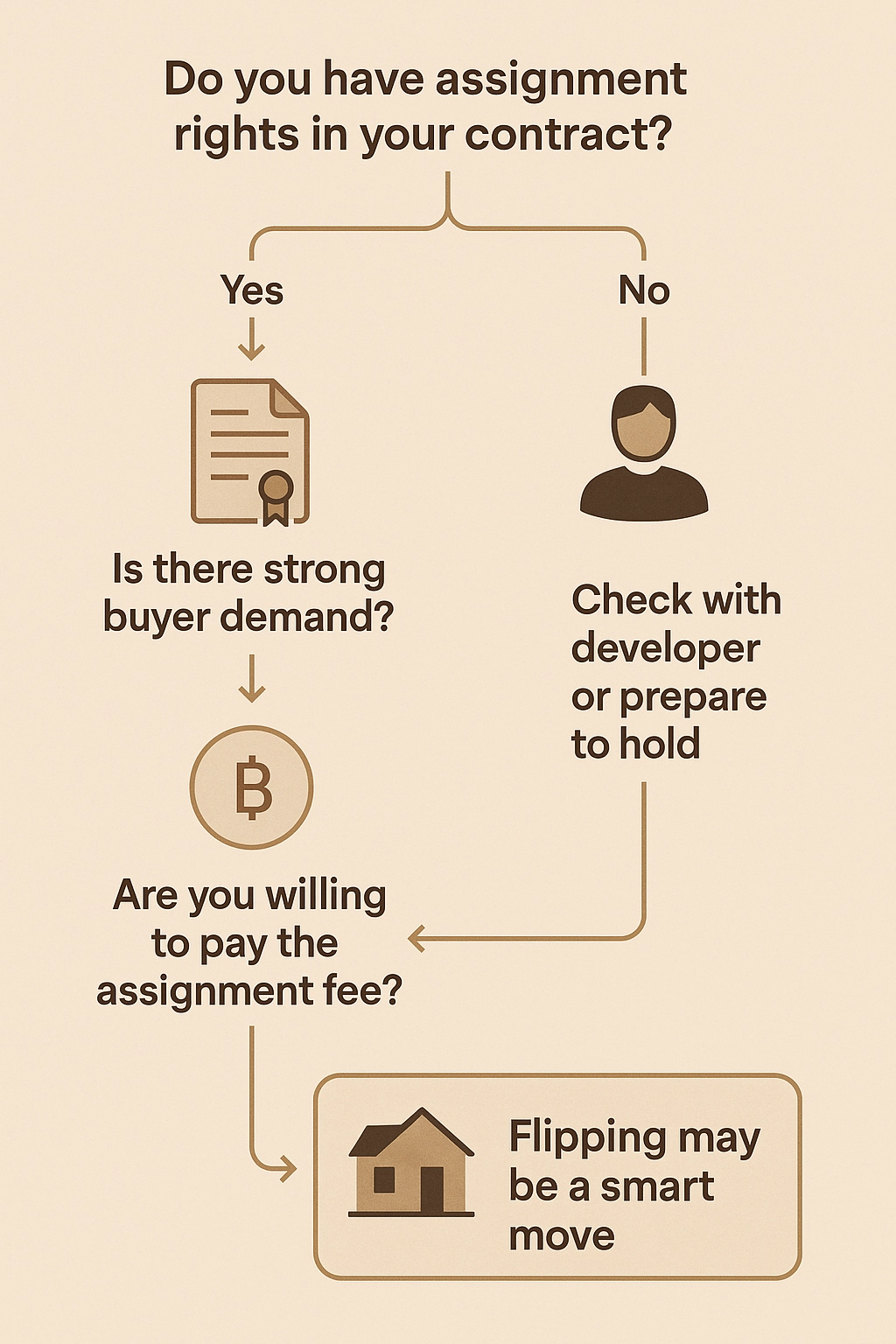
✅ When Flipping Makes Sense
- You bought early at launch pricing — especially in a project that has since raised prices
- It’s a rare unit — corner position, top floor, pool access, sea view, etc.
- There’s buyer demand — maybe the project is nearly sold out, and someone missed their window
- The market is moving upward — and short-term capital appreciation is real
In these cases, flipping can be a tactical play:
Secure early equity, exit cleanly, and move on.
❌ When It’s Risky or Unrealistic
- You’re mid-project in a saturated area with many unsold units
- Interest rates have risen or buyer sentiment has cooled
- The developer is behind schedule or struggling with perception
- You bought a unit with generic appeal — standard floor, no view, common layout
Worse still, some buyers assume they can flip easily — then learn their developer restricts resale, or their pricing isn’t competitive anymore.
Flipping is a strategy. And like any good strategy, it works best when planned from the start — not improvised later out of pressure or regret.
🧠 Remember:
You’re selling a contract, not a product. That means:
- You’ll need to market the unit privately
- A new buyer must be willing to take over your payment schedule
- You’ll need a clear legal path for assignment, ideally supported by the developer
Can This Be a Real Investment Strategy?
Technically? Yes. Strategically? It depends.
Some investors build flipping into their game plan from the start. They buy early, choose projects likely to appreciate mid-construction, and aim to resell the contract before handover. In a rising market — and with the right unit — that can work.
But here’s the catch: It’s not always liquid. And it’s not always profitable.
Unlike resale condos or move-in-ready villas, flipping off-the-plan has friction:
- You’re selling a contract, not a finished product
- You depend on the developer’s assignment policy
- Your pool of potential buyers is smaller
- And your buyer has to be OK picking up staged payments and waiting for completion
What works on paper doesn’t always work in practice.
I’ve seen it succeed in early-phase launches from branded developers, where units were priced aggressively and the project gained traction fast. But I’ve also seen buyers hold out for a flip that never materialized — forced to complete payment and figure out what to do next.
Bottom line:
If you’re flipping opportunistically, that’s fine — just know the rules, and build in margin.
If you’re building a business model around it, you’d better have a pipeline, a resale team, and multiple exit strategies.
Final Tips & Conclusion
Flipping off-the-plan property in Thailand can be done — and in some cases, it can be a smart, clean exit. But it’s not as simple as booking today and cashing out tomorrow.
If you’re thinking about it, here are a few takeaways:
✅ Codi’s Practical Tips:
- Clarify assignment rights before you sign — don’t assume you can flip just because you’ve paid a deposit.
- Know your developer — their reputation, their flexibility, and whether they support contract transfers.
- Think like a buyer — the person taking over your contract is assuming the risk you’re offloading. Is the price fair? Is the timing good?
- Don’t overleverage on the assumption of a flip. If you’re not prepared to finish the payments yourself, you’re speculating — not investing.
Flipping can be part of a wider investment playbook. But it shouldn’t be your only move unless you’re running a volume-based strategy with backup plans.
In a rising market, flipping looks easy. In a flat one, it’s a test of patience and pricing. The real pros know how to navigate both.
If you’re holding an off-the-plan unit and wondering what your options are — or if you want help assessing flip potential before you buy — feel free to reach out. We’ll help you game it out.
Final thought:
You can flip off-the-plan property in Thailand — but only if the stars line up.
It comes down to the contract you signed, the developer’s policy, the strength of the market, and your ability to price and position the resale right.
This isn’t a guaranteed shortcut to profits — and it’s definitely not a get-rich scheme. But with the right unit, good timing, and a clean exit strategy, it can give you the kind of flexibility most real estate investors wish they had.
If you’re sitting on a contract and wondering whether to hold, exit, or pivot — or you’re buying now and want to future-proof your options — we can help.
👉 Reach out for a resale strategy consult, or subscribe to the newsletter to stay ahead of market shifts, developer policies, and assignment-friendly projects.



Join The Discussion