
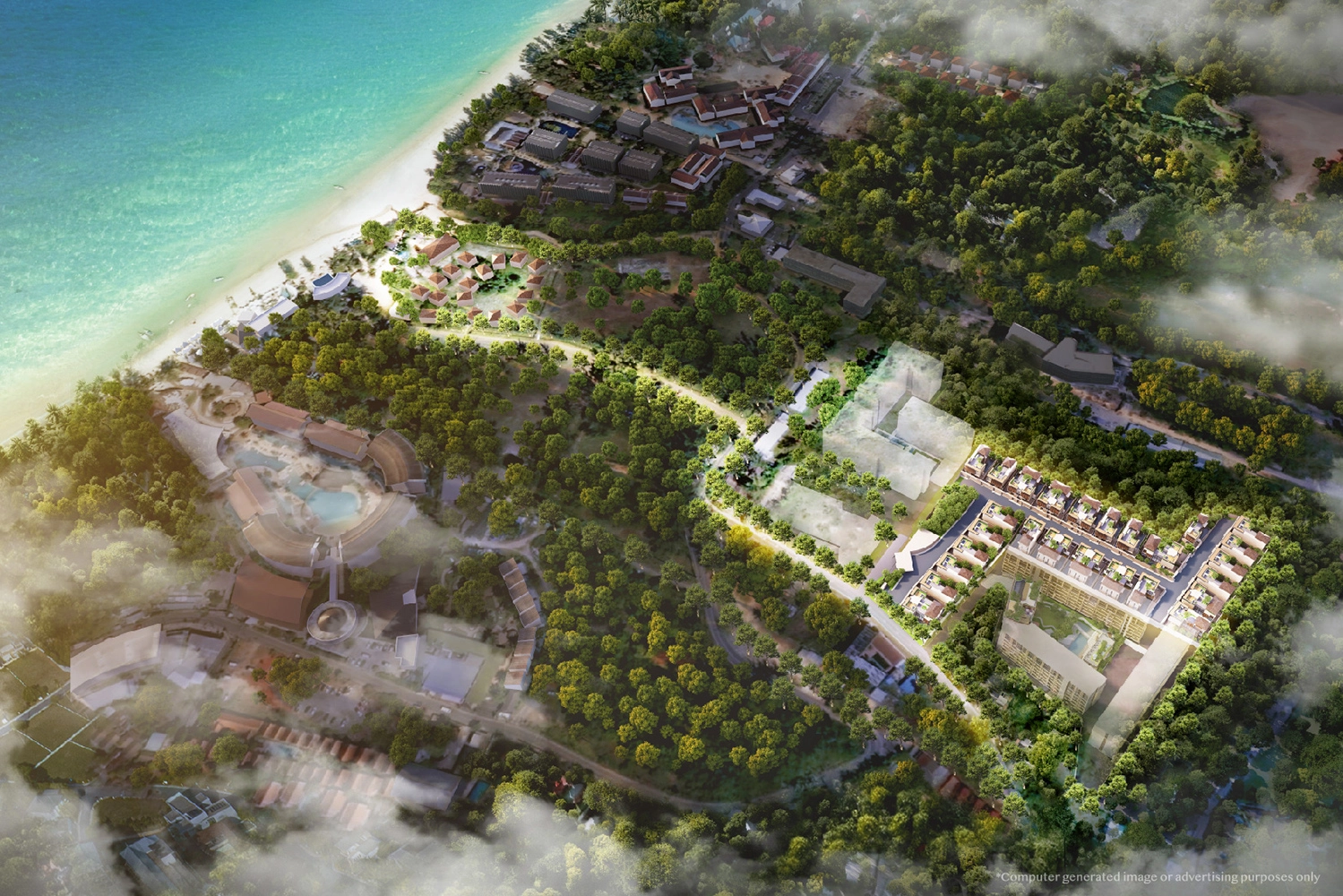
Origin Property is betting big on Phuket, with a B30bn portfolio target by 2028. Before you treat this as a straightforward Phuket investment, see what the debt levels, buyer concentration, and submarket competition actually say about whether that number is realistic.
Table of Contents
Thirty billion baht. That’s the size of the Phuket portfolio Origin Property says it’ll be sitting on by 2028, built out from a standing start on a stretch of Bang Tao land. It’s a big number, the kind that makes headlines and gets shared around property Facebook groups within a day.
Here’s the part that doesn’t quite fit the headline: ORI’s own stock has fallen from Bt11.70 in 2023 to Bt1.82 as of August 2026. That’s not a small dip, that’s a company the market has been pricing down hard for years.
So which version of Origin Property are you supposed to believe? The one making a confident B30bn call, or the one the stock market seems worried about?
Let’s go through the real numbers behind the headline, not just the press release.
What Exactly Is Origin Property Building in Phuket?
Origin Resort World Phuket is the name on the master plan: a 25-rai mixed-use precinct going up in Bang Tao, backed by an initial five-year budget of B11.0bn to B11.65bn running from 2024 through 2029. Think condos, pool villas, a hotel, and a beach club, all sitting on the same stretch of land.
The Three Arms of the Origin Group
Here’s something worth knowing before you go looking at brochures: Origin Property isn’t building all of this under one roof. The group splits execution across three separate entities, each handling a different piece.
Origin Nationwide runs the condo side, with SO Origin Bangtao Beach set at 545 units across three 8-story buildings, worth B2.5bn in gross development value, delivering Q1 2026. Britannia PCL, known as BRI, handles the landed luxury villas through Balco Bangtao Beach, 35 pool villas worth B1.35bn, due Q4 2027. Then there’s One Origin, or ONEO, which takes care of hospitality: the One Origin Hotel Bangtao and the Tichuka Phuket Beach Club.
Quick breakdown
- SO Origin Bangtao Beach (Origin Nationwide): 545 units, B2.5bn GDV, delivery Q1 2026
- Balco Bangtao Beach (Britannia / BRI): 35 pool villas, B1.35bn GDV, delivery Q4 2027
- One Origin Hotel Bangtao + Tichuka Beach Club (ONEO): hospitality and lifestyle assets
Clearing Up the “B600m vs B1.35bn” Confusion
If you’ve read a few articles on this project already, you may have noticed Balco Bangtao Beach gets cited at two very different values: B600m in some places, B1.35bn in others. That’s not a typo and it’s not ORI fumbling its own numbers, it’s two different accounting lenses pointed at the same project.
The B600m figure is the Phase 1 sales launch allocation, essentially the baseline construction budget assigned to the early stage of the build. The B1.35bn figure is the full gross development value, what you get if all 35 villas sell out at their average price of around Bt38.5m each, with individual units ranging from Bt32.1m to Bt69.2m. Same 35 villas, same project, just measured at different stages of the story.
Can Origin Property Actually Afford This? A Look at the Balance Sheet
The Debt Picture Nobody’s Talking About
Here’s where the B30bn story gets less exciting and more important. As of mid-2026, ORI’s total debt-to-equity ratio sits at 142.94%. Put simply, for every baht of shareholder equity the company holds, it’s carrying about 1.43 baht in debt. That’s a lot of borrowed weight to be building beach clubs on.
The net debt-to-equity ratio, which strips out cash on hand, is even less comfortable, ranging between 162.8% and 174.0%. And the interest-bearing debt-to-equity ratio, the slice of that debt actually racking up interest payments, hit 1.59x in 2025. None of these are crisis-level numbers on their own, but stack them together and you get a company with very little room to just borrow its way to B30bn. It’s no surprise management responded by pulling back: fewer land purchases in Bangkok, more focus on clearing existing inventory instead of piling on new debt.
How ORI Is Actually Funding This
So if borrowing more isn’t really the plan, how is ORI paying for Phuket? Two ways, mostly.
First, by selling things. Through 2025, ORI offloaded major hospitality assets, including the InterContinental Bangkok Sukhumvit, which brought in Bt250m in net profit after tax, along with the Staybridge Suites Thonglor and some industrial warehouse holdings. That’s cash raised specifically to pay down debt, not to fund new projects directly.
Second, by bringing in outside money through joint ventures. ORI partners with foreign institutional investors on these Phuket projects, which limits how much of its own equity is exposed. In return, ORI still earns project management fees, historically 20% to 25% of revenue lines, plus a share premium whenever equity gets transferred. It’s a way to keep building without putting the full weight on ORI’s own balance sheet.
| Metric | Value | What it means |
| Debt-to-equity ratio | 142.94% | High leverage, limited room for fresh debt |
| Interest-bearing D/E | 1.59x | Prompted a more conservative capex stance |
| Net debt-to-equity | 162.8% – 174.0% | Signals real liquidity pressure |
| Share price (Aug 2026) | Bt1.82 | Down from Bt11.70 in 2023 |
| Price-to-book | 0.22x | Stock trades at a 78% discount to book value |
| Analyst rating | Hold | Consensus target Bt2.05 to Bt4.20 |
Have They Missed Targets Before?
This isn’t ORI’s first ambitious growth plan, and that history matters here. Back in 2023, the company launched “Origin Infinity,” a plan to expand its footprint nationwide across residential and recurring-income segments. It didn’t land the way it was pitched.
EPS fell from Bt1.11 in 2023 to Bt0.43 in 2024. Total revenue dropped from B15.2bn to B12.0bn over the same period, then kept sliding to a trailing twelve-month figure of B7.01bn by 2025. That’s a meaningful gap between what was promised and what actually showed up on the books, and it’s worth keeping in mind every time you see the B30bn figure mentioned without a completion date attached to it.
Who’s Actually Buying? The Foreign Demand Behind the Numbers
The Buyer Breakdown
Numbers on a masterplan are one thing. Who’s actually signing the contracts is another, and it tells you a lot about how exposed this whole project really is. ORI reports its Phuket buyer mix as 46.6% Russian, 15.9% Polish, 6.4% Chinese, and 31.1% combined Thai and other international buyers.
That’s not a subtle lean toward one market. That’s nearly half the buyer pool coming from a single country.
Does This Match the Bigger Picture?
You could reasonably ask whether ORI is just describing its own bubble, or whether this reflects what’s happening across Phuket more broadly. It checks out. National REIC and Bank of Thailand data for Q1 2026 shows a very similar shift.
Chinese buyers pulled back hard: transfer volume down 38.8% year-on-year, transfer value down 42.9%, with an average unit price of Bt3.9m on 39.9 sqm units. Myanmar buyers dropped too, down 36.4% in volume and 39.0% in value. Russian buyers, meanwhile, went the other way entirely: transfer volume up 33.0%, transfer value up a much steeper 68.7%, on slightly larger average units of 42.1 sqm at Bt4.3m.
Here’s the detail worth sitting with. Russian transfer value grew more than twice as fast as transfer volume. That’s not just more Russian buyers showing up, it’s the same buyers spending more per purchase, moving toward pricier units and villas rather than entry-level condos. And Phuket wasn’t just riding a national trend, it posted the highest provincial transfer value growth in the entire country, up 34.9% year-on-year.
Foreign buyer trends at a glance
- Russian transfer value up 68.7% year-on-year, outpacing 33.0% volume growth
- Chinese transfer value down 42.9% year-on-year
- Polish buyers now a meaningful 15.9% slice of ORI’s Phuket sales
- Phuket logged the highest provincial transfer value growth in Thailand
The Risk Hiding in That Concentration
So what happens if nearly half your buyer pool sits in one country and something changes there? This is the part worth thinking through before you get swept up in the sales numbers.
Russian buyers moving money into Thailand can run into real friction with SWIFT banking restrictions, since it complicates the straightforward cross-border wire transfers a purchase normally needs. Without a properly issued Foreign Exchange Transaction form confirming that money came in from overseas, the Land Office won’t register a foreign freehold title, full stop. Add in ruble volatility on top of that, and you’ve got a scenario where a buyer’s purchasing power can shift meaningfully between signing a reservation and actually completing the deal, raising the odds of deposit defaults or cancelled handovers down the line. None of this means the buyers aren’t real or the demand isn’t genuine. It just means a big chunk of ORI’s sales pipeline runs through a funding channel that isn’t entirely in ORI’s control.
Is Bang Tao Getting Oversaturated?
The Competition Origin Is Walking Into
ORI isn’t building in an empty field. Bang Tao is one of the hottest patches of land in Phuket right now, and pretty much everyone with capital wants a piece of it.
Sansiri has its own B15.0bn expansion running, 16 projects over five years, spread across the island. Banyan Group and Laguna Property are pushing forward with Laguna Lakelands, a masterplanned precinct spanning over 1.0 million sqm, with Skypark Elara (220 units), Laguna Aster (180 units), and ultra-luxury Banyan Tree Oceanus villas all part of the mix. Supalai is in the game too, with its Scenic Bay Condo and a string of independent villa developments.
Zoom out further and the picture gets busier still. C9 Hotelworks tracks 41 hotel projects in Phuket’s pipeline through 2030, enough to push total island supply past 100,000 keys. Bang Tao and neighboring Cherng Talay alone account for roughly 30% of that entire pipeline. That’s a lot of new rooms and units chasing the same pool of buyers and travelers.
What the Hotel Data Actually Shows
Here’s the pattern showing up in the hotel numbers, and it’s worth understanding because it tells you what’s happening beneath the headline growth: properties across Phuket are largely holding their room rates up even as occupancy softens. Essentially, hotels are choosing rate over volume.
| Submarket | ADR change (2025) | Occupancy change (2025) |
| Phuket island-wide | +5.0% | -6.0% (to 76.0%) |
| Bang Tao / Cherng Talay | +20.0% | -2.0% |
| Surin | +21.0% | -9.0% |
| Kamala | Premium pricing held | -24.0% |
Bang Tao actually came out ahead of the pack in 2025, posting the strongest rate growth on the island while barely losing any occupancy. That’s a good look on paper. But the more recent data complicates the story: Cushman & Wakefield’s 1H 2026 figures show broader cooling, with luxury and upscale RevPAR falling 8.7% to Bt5,456 as new supply started landing. And there’s more coming. Island-wide, 3,440 luxury and upscale rooms are currently under construction for delivery between 2026 and 2028, a 7% expansion to existing supply.
What This Means for ORI’s 10% Rental Yield Promise
This is the part that actually matters if you’re considering putting money in. ORI’s Investment Program advertises 10% gross annual rental returns on its condo units. That number sounds great in a brochure, but it’s worth pressure-testing before you bank on it.
Management fees in these pooled rental arrangements typically eat up 30% to 40% of room revenue before an owner sees a baht. Add rising competition from established operators like Banyan Group, who can undercut on brand strength and occupancy alone, and that headline 10% starts looking a lot less realistic. A more grounded expectation for net yield sits somewhere between 3.5% and 5.5%. Still worth having, just not the number on the flyer.
The Legal Side: What Foreign Buyers Need to Know Before Signing
The 49% Freehold Rule, Explained Simply
Before you get excited about any unit in Bang Tao, there’s a rule you need to understand. Under the Thai Condominium Act, foreigners can own up to 49% of a condo building’s total usable floor area on a freehold title. The other 51% has to belong to Thai nationals or Thai corporate entities. That’s not negotiable, it’s the law.
Here’s where it gets interesting for a project like ORI’s. In Bang Tao specifically, foreign demand for presales often runs 60% to 70%, well past that 49% ceiling. So the demand is clearly there, the question is what happens to the buyers who can’t fit under the quota.
Leasehold, Nominee Structures, and Where the Risk Sits
The most common answer is a 30-year registered leasehold, usually with renewal options built in. Leaseholds come with a real upside: registration fees run at 1.1%, noticeably lower than standard freehold transfer fees. The trade-off is that leasehold units have historically seen weaker capital appreciation and take longer to resell than freehold ones. It’s a workable structure, just not an identical one.
The other route you’ll hear about is a Thai nominee corporate structure, essentially setting up a Thai company to hold the property and access the 51% Thai quota. This has been used for years, but it’s getting riskier by the month. The Ministry of Commerce and local Land Offices have ramped up nominee audits through 2025 and 2026, and buyers using this route to sidestep the freehold cap are taking on real legal exposure they may not fully understand at signing.
Before you buy foreign freehold in Phuket, check:
- Is the building’s 49% foreign quota already filled?
- Do you have a valid FET form ready for the bank transfer?
- Is a leasehold structure being pitched instead, and do you understand the resale trade-offs that come with it?
- Is it clear which entity, ORI, BRI, or ONEO, you’re actually contracting with?
How Does ORI’s Plan Stack Up Against the Competition?
ORI isn’t the only developer with big ambitions for Phuket right now. Here’s how its plan compares against the other major players building in the same market.
| Developer | Stated Phuket strategy | Buyer focus | Biggest risk |
| Origin Property (ORI) | B30bn by 2028 | Russian, Polish, Chinese | High leverage, delayed ONEO IPO |
| Sansiri | B15bn, 16 projects | Domestic Thai, foreign holiday buyers | Heavy competition in mid-to-high condo tiers |
| Banyan Group / Laguna | Multi-decade master precinct | Ultra-wealthy global investors | High entry prices, slower resale |
| Supalai | Multi-year rolling expansion | Value-focused, regional Asian buyers | Less brand premium |
On paper, Origin’s B30bn target is roughly double the size of Sansiri’s B15bn plan. But size alone doesn’t win this comparison, Sansiri carries meaningfully less balance sheet leverage and has a stronger track record of actually completing handovers on schedule. And then there’s Banyan Group and Laguna, playing an entirely different game: 2,147 units delivered since 1993, backed by an integrated resort ecosystem of golf courses, shuttle buses, and beach clubs that a newer entrant simply can’t replicate in a few years, no matter how big the number on the press release is.
So, Is the B30bn Target Realistic?
Here’s the honest answer: reaching B30bn in launched, announced gross development value by 2028 is very achievable. ORI just has to keep announcing projects and opening presales, and the number takes care of itself. Actually completing, transferring, and booking that value as recognized revenue by 2028 is a much taller order, given a debt-to-equity ratio of 142.94%, tight liquidity, and a funding model that leans heavily on selling assets and bringing in outside JV equity just to keep construction moving.
So the headline number and the real number aren’t the same thing. Here’s what could push things in either direction.
What Could Go Right
- Bang Tao keeps commanding rate premiums even as occupancy softens across the rest of the island
- Foreign demand, especially Russian capital (up 68.7% in transfer value) and Polish buyers, keeps flowing into the submarket
- The asset-light, JV-heavy funding model limits how much of the actual risk sits on ORI’s own balance sheet
- The Phase II airport expansion, adding 44% more passenger capacity by 2030, and the Kathu-Patong tunnel improve long-term access to the area
What Could Go Wrong
- Debt stays tight and the One Origin (ONEO) IPO, which was meant to bring in fresh capital, keeps getting pushed back
- A shift in Russian capital flows, tighter SWIFT restrictions, or ruble volatility disrupts deposit collection and slows down handovers
- Bang Tao supply keeps growing faster than demand, pulling yields further below the promised 10%
- Tighter enforcement on nominee ownership structures cools foreign buyer momentum
Put those two lists side by side and you get the real shape of this story. It’s not a scam and it’s not a slam dunk either. It’s a leveraged company making a plausible bet on a genuinely strong submarket, and 2028 will tell you which list won out.
Bottom Line for Investors and Buyers
So where does that leave you, if you’re actually weighing this rather than just reading about it?
Here’s what we’d watch. Start with the quarterly debt-reduction numbers, not the announcements, the actual filings. A company carrying this much leverage needs to show consistent progress, not just promises that it’s “managing” the situation. Then look past the sales headlines to the cash collection figures. Any developer can announce a strong presale number, what matters is how much of that money is actually landing in the bank from foreign buyers, especially given how much of ORI’s pipeline runs through Russian capital that has to clear real banking friction to get here.
Keep an eye on the One Origin IPO too. That listing was supposed to bring in fresh capital and ease some of the pressure on the balance sheet, and every quarter it stays delayed is a quarter ORI leans harder on asset sales and JV partners to keep building. And watch Bang Tao’s hotel occupancy specifically. The submarket held up well in 2025, but 1H 2026 already showed cracks. Whether that stabilizes or keeps sliding tells you a lot about whether ORI’s 10% yield promise has any real chance of holding up.
None of this means walk away. It means pay attention. Right now, Origin Property looks like a high-yield, higher-risk turnaround story, not a company you back with your eyes closed. Watch it closely. Don’t chase it blindly.
Frequently Asked Questions About Origin Property’s Phuket Plans
Is Origin Property’s B30bn Phuket target realistic by 2028? Launching enough projects to hit B30bn in gross development value by 2028 is realistic, ORI can announce and presell its way there without much trouble. Actually completing those projects and booking that value as recognized revenue is a different story, and with a debt-to-equity ratio of 142.94%, that part is far less certain.
What is Origin Resort World Phuket Bangtao Beach? It’s ORI’s master-planned 25-rai precinct in Bang Tao, built to combine condos, luxury villas, and hospitality under one location. Origin Nationwide handles the condos, Britannia (through Balco Bangtao Beach) handles the luxury pool villas, and One Origin runs the hotel and lifestyle side.
Who is buying property in ORI’s Phuket projects? Russian buyers make up the largest share at roughly 46.6%, followed by Polish buyers at 15.9%, Chinese buyers at 6.4%, and Thai and other international buyers making up the remaining 31.1%. That mix closely tracks national REIC transfer data, so it’s not just ORI’s own bubble, it reflects broader trends across Phuket.
Can foreigners own 100% of a condo in Phuket? No, foreign freehold ownership is capped at 49% of a building’s total floor area under the Thai Condominium Act. The remaining 51% has to stay in Thai hands, which is exactly why leasehold structures are such a common workaround for buyers who fall outside that quota.
Is Origin Property (SET: ORI) a good stock to buy right now? Right now, analyst consensus sits at “Hold,” not a “Buy.” The stock trades at a steep discount to book value (P/BV of 0.22x), and most analysts are waiting to see real debt reduction and clearer cash collection before they’d consider upgrading it.
Is Bang Tao oversupplied with hotels and condos? There’s a real oversupply risk building in the area. Bang Tao and neighboring Cherng Talay account for roughly 30% of Phuket’s entire upcoming hotel pipeline, and with several major developers building there at the same time, some price tiers are likely to feel the squeeze first.
If you want to keep learning without the noise, we share one clear perspective each week in The Hawook Weekly.
It’s focused on Southeast Asia property, written for people who want to understand how things actually work, not chase headlines.
- Practical property intelligence
- Delivered every Tuesday
- Because knowledge is leverage, and leverage creates wealth
You can subscribe here: https://www.news.hawook.co or check out our app here: https://app.hawook.com

Join The Discussion