
 by
by 
Smart Grid Eco Villas are quietly reshaping Phuket luxury real estate by reducing the hidden costs that come with tropical villa ownership. From lower electricity bills and smarter energy use to improved Phuket rental yield during low season, these sustainable luxury villas combine solar power, battery storage, and energy-efficient design to create more resilient long-term investments.
Table of Contents
Most people assume the expensive part of owning a luxury villa in Phuket is the purchase price.
The ocean views.
The land prices.
The imported stone countertops.
The infinity pool hanging over a hillside in Bang Tao.
That part’s obvious.
What catches many investors off guard is what happens after the villa sits empty.
Especially during low season.
Every year, Phuket’s luxury real estate market follows the same rhythm. High season arrives around November, bookings flood in, nightly rates climb, and luxury villas Phuket owners feel pretty good about their numbers.
Then monsoon season rolls around.
Flights slow down. Tourist traffic softens. Occupancy drops. Some villas sit empty for weeks at a time.
But the bills don’t stop.
That’s the part people rarely talk about when discussing Phuket rental yield.
In tropical climates like Phuket, an empty villa still behaves like a living thing that needs constant attention. Humidity builds fast. Mold creeps into wardrobes and ceilings. Wooden furniture swells. Leather starts smelling damp. Pool systems keep circulating. Air conditioning systems keep running in dry mode just to stop the place from quietly falling apart.
And electricity in Phuket isn’t cheap when you’re cooling large open-plan luxury homes.
So even when a villa generates zero rental income, it still consumes power every single day.
That changes the math completely.
A villa that looks profitable during peak season can quietly bleed money during the rainy months through carrying costs most buyers underestimate.
Especially investors buying Phuket luxury real estate from overseas.
Because from a distance, gross rental returns always look cleaner than reality.
This is exactly why smart grid villas Phuket developers are starting to attract attention.
Not because they look futuristic.
Most of them don’t.
The interesting part is operational. Quietly operational.
A new wave of eco-focused luxury developments in Phuket are using decentralized energy systems, solar microgrids, battery storage, and shared internal power networks to reduce the financial drag that usually comes with low-season vacancy.
And in some cases, empty villas are no longer just sitting there consuming electricity.
They’re helping generate energy for the wider community.
Which is a pretty interesting shift in a market where vacant homes have traditionally been expensive liabilities.
Especially in a place like Phuket, where the climate never really lets a property rest.
The Hidden Cost of Owning a Luxury Villa in Phuket
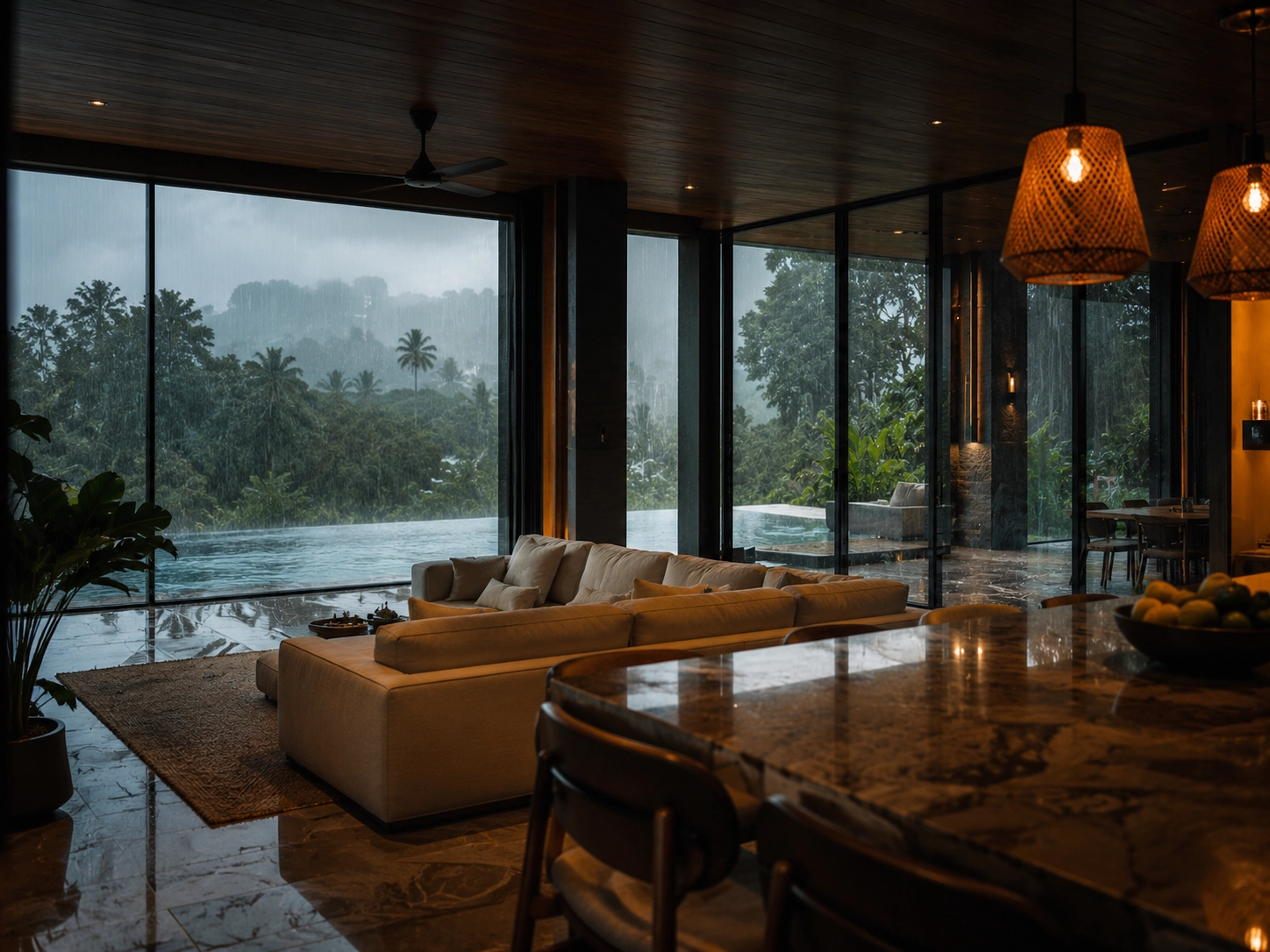
One of the biggest misconceptions about owning luxury villas Phuket is that expenses disappear once the guests leave.
In reality, tropical property works the opposite way.
A villa in Phuket can sit completely empty and still quietly burn through electricity every single day.
That surprises a lot of first-time investors.
Especially overseas buyers who only see the glossy side of Phuket property investment. The ocean views. The rental projections. The high-season occupancy numbers.
What they don’t always see are the ongoing Phuket villa operating costs that continue whether somebody is living there or not.
Because Phuket’s climate never really switches off.
Even during low season, the combination of heat, moisture, salt air, and humidity puts constant pressure on a property. Leave a villa sealed up for too long without proper climate control and things start deteriorating faster than most people expect.
Not dramatically overnight.
Just slowly. Quietly. Expensively.
Why Tropical Climates Make Empty Villas Expensive
Humidity is the real villain here.
Not the kind you notice during a beach holiday. The kind that creeps into wardrobes, air vents, curtains, mattresses, and wooden cabinetry after weeks of trapped moisture.
Property managers in Phuket deal with this constantly during monsoon season.
A villa owner might leave for six weeks thinking they’re saving money by shutting systems down. Then they come back to a house that smells damp the second the front door opens.
Closets smell musty.
Leather furniture feels sticky.
Wooden doors swell slightly from moisture.
Ceilings develop tiny mold spots around air vents.
And suddenly the “savings” disappear into maintenance bills.
That’s why many luxury villas Phuket keep air conditioning systems running in dry mode even while vacant. Not for comfort. Just for survival.
The villa basically needs to breathe.
Pool systems also keep running. Water filtration can’t simply stop in a tropical climate unless owners want green water and damaged equipment waiting for them later. Security systems, outdoor lighting, internet routers, water pumps, and monitoring systems stay active too.
Some villas even leave water heating systems partially operational for staff use and maintenance checks.
Which means an “empty” villa is never truly off.
It’s just operating in preservation mode.
And preservation mode still costs money.
The Real Monthly Utility Costs of Phuket Luxury Villas
This is where Phuket utility costs start catching investors off guard.
A modern three-bedroom luxury villa in areas like Cherngtalay or Bang Tao can easily generate electricity bills between 7,000 to 10,000 THB per month during occupied periods.
But even vacant villas often continue producing surprisingly high monthly costs.
Especially during rainy season.
A realistic scenario looks something like this:
An owner leaves Phuket in June for a two-month trip through Europe. Before leaving, they lower the air conditioning settings, keep the pool circulation running, leave Wi-Fi and security systems active, and ask their Phuket property management company to monitor the house weekly.
They assume the electricity bill will be minimal.
Instead, they return in August to:
- a damp smell throughout the villa
- slightly swollen wooden cabinets near the kitchen
- condensation marks on windows
- mold beginning around storage areas
- a utility bill that still feels strangely high for an “unused” property
That’s the hidden math behind luxury ownership in tropical markets.
Vacancy doesn’t eliminate operational costs.
Sometimes it simply changes where the money goes.
Typical Hidden Costs of a Vacant Phuket Villa
- Air conditioning running in dry mode
- Humidity and mold prevention
- Pool pumps and filtration systems
- Outdoor lighting and security systems
- Water circulation and filtration
- Wi-Fi and smart home systems
- Routine maintenance visits
- Landscaping and pest control
- Appliance standby power usage
This is also why experienced investors in Phuket luxury real estate eventually stop focusing only on purchase price.
The smarter ones start paying attention to operational efficiency instead.
Because over time, recurring carrying costs quietly shape the real profitability of a villa far more than most brochures admit.
Why Seasonal Occupancy Crushes Rental Yields
Phuket has always been a seasonal market.
That’s part of the appeal, honestly.
From November through April, the island feels electric. Beach clubs are full, restaurants are packed, international flights keep landing, and luxury villas across Bang Tao, Surin, and Layan start filling up fast.
For villa owners, those months can look incredibly profitable.
Strong occupancy.
Premium nightly rates.
Solid monthly cash flow.
On paper, Phuket rental yield can look very attractive during high season.
Especially in the luxury segment.
This is usually the phase where investors fall in love with the numbers.
The problem is those numbers only tell half the story.
Because Phuket’s property market behaves very differently once monsoon season arrives.
High Season Looks Amazing on Paper
During peak season, many luxury villas Phuket operate close to full occupancy.
Families escaping European winters. Remote business owners staying for months. Wellness travelers. Long-stay digital nomads. The demand can feel endless between December and March.
In high-demand areas like Cherngtalay and Bang Tao, premium villas can command nightly rates that look impressive even by international resort standards.
This is why Phuket property investment keeps attracting overseas buyers.
At first glance, the equation feels simple:
- strong tourism market
- growing luxury segment
- relatively affordable compared to Bali or Dubai
- attractive gross rental returns
And technically, those assumptions aren’t wrong.
Phuket can absolutely generate strong seasonal income.
The issue is what happens outside those perfect six months.
Because luxury villa ownership isn’t a seasonal expense.
It’s a year-round expense.
Then Monsoon Season Hits
Around May, the rhythm changes.
Rain becomes more frequent. Tourist arrivals soften. Short-term booking demand slows down. Some travelers postpone trips entirely. Others negotiate harder on pricing.
Occupancy starts slipping.
Then owners begin discounting.
A villa that commanded premium nightly rates during January suddenly competes in a much quieter market where everyone is lowering prices at the same time.
This is where low season Phuket villas start revealing the real economics behind ownership.
Revenue drops faster than expenses do.
That’s the key issue.
Even if occupancy falls by 40% or 50%, the villa still needs:
- cooling systems running
- pool maintenance
- landscaping
- security monitoring
- housekeeping visits
- internet systems
- humidity control
- ongoing Phuket property management
The operational machine never fully stops.
And this creates a subtle pressure many investors underestimate during the buying phase.
Especially overseas buyers focused mainly on projected income.
Why Net Yield Matters More Than Gross Yield
Gross yield is easy to market.
Net yield is where reality lives.
A villa brochure might show impressive annual rental projections based on peak-season occupancy and premium nightly rates. And technically, those numbers can be achievable during the best months of the year.
But net rental yield Phuket investors actually keep depends on what happens after operational costs start eating into that income.
That distinction matters a lot in tropical resort markets.
For example, two villas might generate similar rental revenue during high season.
But if one property quietly burns through large electricity bills, maintenance costs, and humidity-related repairs during low season, the actual profitability starts looking very different over a full year.
This is why experienced investors eventually stop asking:
“How much revenue can this villa generate?”
And start asking:
“How expensive is this villa to carry when nobody’s staying there?”
That second question usually leads to much better decisions.
Especially in Phuket, where seasonality affects almost everything.
What Is a Smart Grid Villa?
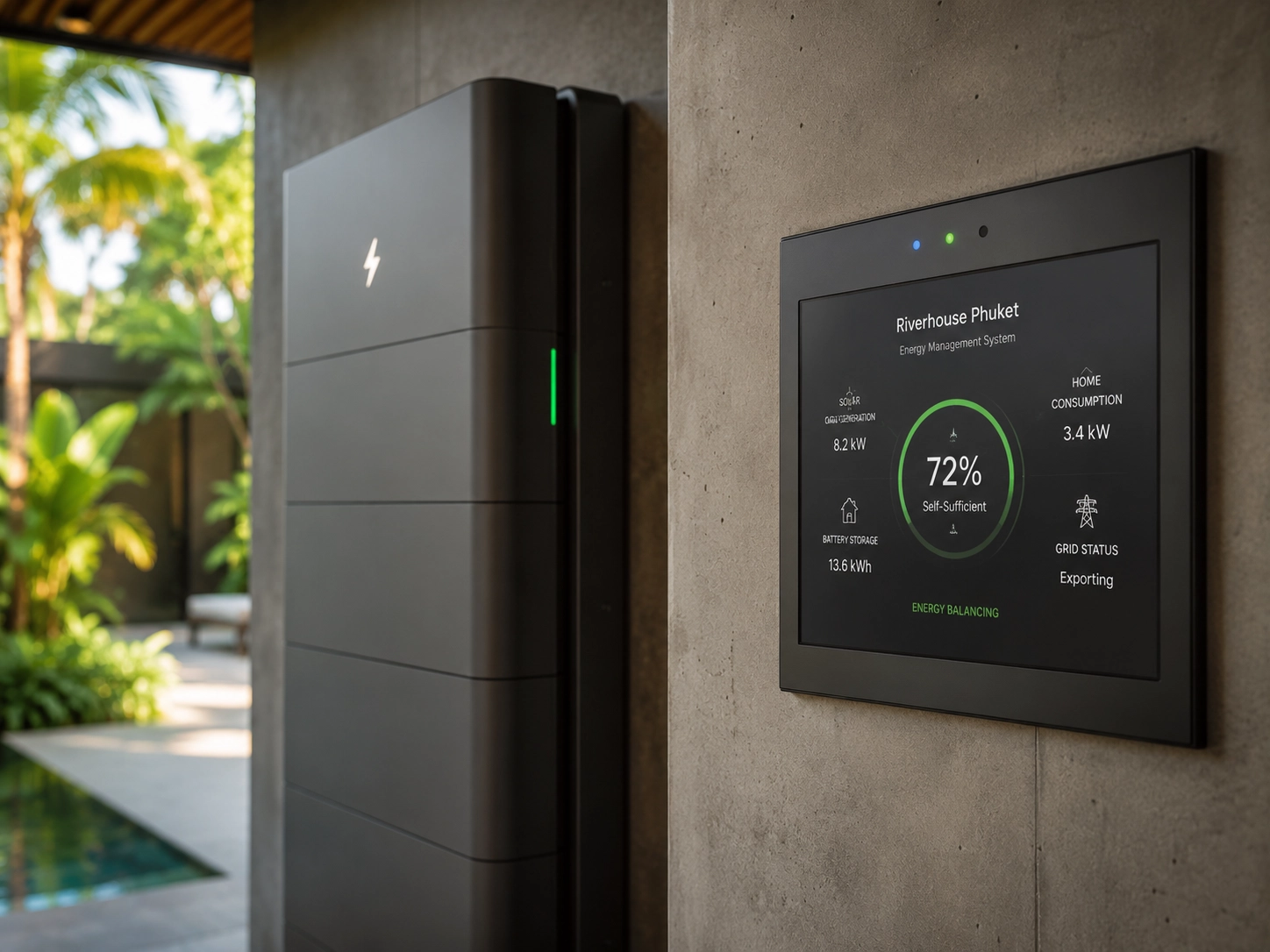
Most villas in Phuket work the same way.
They pull electricity from the public grid, use what they need, and pay the monthly bill.
Pretty straightforward.
Even if a villa has rooftop solar panels, it usually still operates like an isolated house. The solar power gets used locally, and any excess energy often goes nowhere useful if the villa is sitting empty.
That’s where smart grid villas Phuket start doing things differently.
At a basic level, a smart-grid villa is still a luxury home.
It just happens to be connected to a smarter energy system behind the scenes.
Think:
- rooftop solar panels
- battery storage
- shared private energy networks
- automated balancing between homes
The important part isn’t the technology itself.
It’s what the technology changes financially.
Because instead of every villa operating alone, the homes become part of a connected energy-sharing ecosystem.
And in a seasonal market like Phuket, that changes the economics quite a bit.
The Traditional Villa Setup vs Smart Grid Setup
A traditional luxury villa behaves like a standalone energy consumer.
It takes power from the grid.
Uses electricity for cooling, lighting, pools, and appliances.
Then pays whatever the utility bill happens to be.
Simple.
But also slightly wasteful.
Especially during low season.
For example, imagine a villa owner leaves Phuket for six weeks during monsoon season. The villa still generates solar energy during the day, but because nobody’s there to use it, much of that energy becomes underutilized.
The house keeps operating independently, even when empty.
Smart-grid villas work differently.
Instead of acting like isolated houses, they become connected participants inside a shared private network.
One villa may be vacant.
Another villa nearby may be occupied and running heavy air conditioning all day.
Rather than wasting excess solar production from the empty property, the system redistributes energy internally where it’s needed most.
That’s the core idea behind decentralized smart grids.
Not flashy technology.
Just smarter energy flow.
How Peer-to-Peer Energy Sharing Actually Works
This is the part that sounds complicated until someone explains it normally.
A smart-grid community uses:
- solar panels for daytime generation
- battery storage for backup power
- software that monitors energy use across the development
- a private internal distribution system
When one villa generates more electricity than it needs, that surplus can help support another villa inside the same network.
It’s basically:
“Like neighbors sharing Wi-Fi bandwidth, except it’s electricity.”
The important detail is that this usually happens inside a private system rather than through Thailand’s public power grid.
That’s why terms like behind-the-meter microgrids matter.
The energy stays inside the development’s own internal infrastructure.
So instead of exporting unused solar power into the public grid, the community balances energy demand internally between villas.
In practice, it’s much less futuristic than it sounds.
Most residents probably don’t even think about it day to day.
The system just quietly works in the background:
- charging batteries
- reducing grid dependency
- balancing surplus energy
- lowering operational costs
And during power outages, battery storage can also help villas continue operating temporarily without disruption.
Which matters more than people think during Phuket storm season.
Why This Matters During Phuket’s Low Season
This is where smart-grid economics become interesting.
In a normal villa setup, vacancy creates dead operational weight. An empty property still consumes electricity without generating any financial return.
But inside solar powered villas Phuket developments with shared energy infrastructure, vacant villas can still contribute value through surplus solar generation.
That changes the relationship between occupancy and operational costs.
Especially during low season.
A villa sitting empty during monsoon months may still produce solar energy every day. Instead of wasting that energy, the system redistributes it internally to occupied villas with heavier cooling loads.
Which means the vacant property becomes less of a financial drain.
In some cases, operational carrying costs shrink dramatically.
That’s why peer-to-peer energy trading Thailand discussions have started gaining attention inside luxury real estate circles.
Not because buyers suddenly became obsessed with solar infrastructure.
Most don’t care about technical specifications.
They care about:
- lower utility bills
- more stable operating costs
- better resilience during outages
- stronger long-term Phuket rental yield
And increasingly, those things are starting to matter just as much as ocean views and imported marble kitchens.
Riverhouse Phuket: The Case Study Everyone’s Watching
A lot of sustainability talk in real estate still feels pretty cosmetic.
A few rooftop solar panels. Some recycled wood finishes. Maybe a few marketing photos with plants everywhere.
But every now and then, a project comes along that actually tries to rethink how luxury villas operate day to day.
That’s what makes Riverhouse Phuket interesting.
Not because it looks radically different from other luxury developments in Cherngtalay.
Honestly, aesthetically, it still fits the modern Phuket villa language people already know. Clean architecture. Industrial loft styling. Open spaces. Pool villas designed for tropical living.
The difference is what’s happening underneath the surface.
Riverhouse Phuket was built as a 51-villa smart-grid community where energy efficiency and operational costs were considered from the beginning, not added later as a marketing layer.
And in a market where vacant villas quietly drain money every monsoon season, that shift matters more than most buyers initially realize.
What Makes Riverhouse Phuket Different
Most luxury villas Phuket developments still operate like separate islands.
Each villa manages its own electricity, cooling, water systems, and operational load independently.
Riverhouse Phuket approaches things more like a connected ecosystem.
The development combines:
- rooftop solar systems
- shared energy balancing
- battery storage
- insulated construction
- double-glazed windows
- centralized water filtration
- rainwater harvesting systems
- efficient cooling infrastructure
All of this is designed around one simple idea:
Reduce the long-term operational burden of tropical villa ownership.
That sounds less exciting than infinity pools and imported stone finishes.
But for long-term owners, it’s arguably more important.
Especially for buyers planning to spend only part of the year in Phuket.
One reason Riverhouse Phuket keeps attracting attention inside sustainable real estate Thailand conversations is because the project addresses a very specific tropical problem:
How do you stop empty villas from becoming expensive liabilities?
That question sits underneath almost every design choice in the development.
The Technology Behind the Project
This is where some projects lose readers by becoming overly technical.
Riverhouse actually becomes more interesting once you simplify it.
At its core, the development works like a private energy-sharing neighborhood.
Each villa includes solar panels and battery storage systems that collect and store energy during the day. The villas are then connected through a shared internal energy network that helps balance electricity usage across the community.
So instead of every villa operating completely alone, the system quietly redistributes energy where it’s needed most.
The project also reduces energy demand itself through smarter construction choices.
Double-glazed windows help reduce heat transfer. Insulated walls stabilize indoor temperatures. Efficient cooling systems reduce the amount of electricity needed to keep villas comfortable in Phuket’s humidity.
Even the water systems were designed more thoughtfully than standard luxury builds.
Rainwater harvesting and centralized filtration help reduce dependency on external infrastructure while improving long-term operational efficiency.
None of this feels flashy when you walk through the property.
That’s kind of the point.
Good infrastructure usually disappears into the background.
But operationally, these details change the economics quite a bit compared to traditional solar powered villas Phuket buyers may have seen before.
The “Negative Utility Bill” Concept
This is probably the most interesting part of the entire model.
And also the easiest part to misunderstand.
Normally, when a villa sits empty, it still costs money to maintain. Electricity bills continue because cooling systems, dehumidifiers, pool pumps, filtration systems, and security infrastructure still need power.
At Riverhouse Phuket, the math changes slightly.
Because vacant villas can still generate solar energy during the day.
If that villa isn’t using much electricity itself, the surplus energy can help support occupied villas elsewhere inside the private network. The system internally balances energy demand between homes.
Which means the vacant villa may partially offset its own operational costs through shared energy contribution.
That’s what people mean when discussing the “negative utility bill” idea.
Not that owners suddenly get rich from electricity.
More that the villa stops behaving like a constant financial drain during low season.
That distinction matters.
Especially in Phuket, where low occupancy months are often what separate profitable ownership from stressful ownership.
Why Expats and Remote Workers Love This Setup

Interestingly, many renters care less about the technical infrastructure itself and more about the lifestyle outcome it creates.
Reliable cooling.
Stable electricity.
Lower utility costs.
Less worry during storms.
Quieter systems running in the background.
For long-stay expats and remote workers, those details become surprisingly valuable after a few months in Phuket.
Especially for people used to working remotely full-time.
A villa with stable energy systems and lower operating friction simply feels easier to live in.
And that’s part of why smart homes Phuket discussions are starting to shift away from gimmicky automation and toward operational resilience instead.
Because increasingly, modern luxury isn’t just about how impressive a villa looks on arrival day.
It’s about how intelligently it functions six months later when the weather turns, occupancy drops, and the island slows down a little.
Do Smart Grid Villas Actually Save Money?
This is usually the point where people become skeptical.
The idea sounds good in theory:
solar panels, battery systems, smarter infrastructure, lower energy usage.
But do smart-grid villas actually save meaningful money in real life?
Or is this just expensive sustainability branding wrapped around luxury real estate?
Honestly, the answer sits somewhere in the middle.
Eco villas Phuket still cost more upfront than traditional luxury builds. There’s no way around that. Solar infrastructure, battery storage, insulation systems, and energy-efficient mechanical design all increase development costs.
But operationally, the numbers start looking very different over time.
Especially in Phuket, where climate-related expenses never really disappear.
Comparing Traditional Villas vs Smart Grid Villas
A traditional luxury villa in Phuket usually relies heavily on the public electricity grid.
That becomes expensive quickly because tropical villas consume a lot of power just staying functional:
- air conditioning
- humidity control
- pool filtration
- outdoor lighting
- water systems
- hot water heating
And most of those systems keep running whether the villa is occupied or not.
Smart-grid villas reduce some of that pressure through a combination of:
- solar generation
- battery storage
- better insulation
- efficient cooling systems
- shared energy balancing
- lower grid dependency
The result isn’t zero operating cost.
That’s important.
But it can significantly reduce the long-term drag that comes with tropical property ownership.
Here’s the simplified version:
| Operational Area | Traditional Luxury Villa | Smart Grid Villa |
| Cooling Costs | High grid usage | Reduced through insulation + solar |
| Humidity Control | AC dry mode running constantly | Lower energy dehumidification systems |
| Pool Energy Usage | Standard continuous consumption | More efficient variable-speed systems |
| Grid Dependency | Heavy reliance on PEA grid | Reduced through solar + batteries |
| Vacancy Carry Costs | Ongoing financial drain | Lower operational burden |
| Power Outage Resilience | Limited | Partial battery backup |
| Excess Solar Production | Often wasted | Internally redistributed |
One of the more interesting shifts happens during vacancy periods.
In traditional villas, empty months still generate utility bills with no financial return attached.
Inside smart-grid communities, surplus solar generation can sometimes offset part of those carrying costs through internal energy balancing and utility credits.
Again, not life-changing money.
But enough to meaningfully improve long-term Phuket villa operating costs over time.
Especially for owners who only use their villas seasonally.
The Green Premium: Why Buyers Pay More
This is where investor psychology becomes interesting.
Because buyers paying a premium for sustainable villas usually aren’t just buying solar panels.
They’re buying predictability.
That matters more than people think.
Many experienced Phuket property investment buyers eventually realize the most stressful part of ownership isn’t the purchase itself. It’s the uncertainty around long-term operating costs:
- rising electricity prices
- maintenance surprises
- seasonal vacancy pressure
- climate-related wear and tear
Energy efficient villas Phuket developments attempt to reduce some of that uncertainty.
Not eliminate it completely.
Just reduce the friction.
That’s part of why projects like Riverhouse Phuket have managed to command stronger pricing compared to more conventional luxury developments nearby.
Buyers increasingly see operational efficiency as part of the luxury equation itself.
Not separate from it.
And renters notice too.
Especially long-stay expats and remote workers who care about monthly living costs, stable infrastructure, and reliable cooling systems during Phuket’s hotter months.
That combination can strengthen long-term resale positioning as well.
Because sustainable infrastructure ages differently than purely aesthetic luxury trends.
Marble styles change.
Furniture trends change.
Operational efficiency usually stays useful.
The 10-Year Payback Question
This is the part where conversations become more practical.
Most smart-grid villas carry a higher upfront cost compared to standard luxury builds. Between solar systems, battery storage, insulation upgrades, and more efficient infrastructure, buyers are effectively paying an additional premium at purchase.
So naturally, people ask:
“How long does it take to earn that money back?”
The honest answer depends on usage patterns.
A full-time resident living in the villa year-round will experience savings differently than an investor renting seasonally.
But in many cases, the operational savings accumulate gradually through:
- lower electricity bills
- reduced cooling costs
- lower humidity-management expenses
- reduced grid dependency
- smaller vacancy carrying costs
Battery replacement also becomes part of the long-term equation eventually. Most storage systems still have lifecycle limitations.
But even then, many buyers view the tradeoff similarly to upgrading insulation or improving structural quality in a home.
It’s less about immediate profit.
More about building a property that functions better over time.
And increasingly, that mindset is becoming part of modern Phuket luxury real estate.
What Buyers Are Really Paying For
- Lower long-term utility costs
- Better energy efficiency
- Reduced low-season carrying pressure
- More stable operational expenses
- Improved climate resilience
- Better comfort during year-round living
- Reduced dependency on public infrastructure
- Stronger long-term resale positioning
- More predictable ownership economics
The important thing is not to romanticize sustainability too much.
Smart-grid villas are still luxury assets. They still require maintenance, management, and long-term planning.
But compared to traditional villas built purely around aesthetics, they often behave more intelligently operationally.
And in Phuket, that difference becomes surprisingly valuable once the rainy season arrives.
The Legal Side: Are Smart Grids Even Allowed in Thailand?
At this point, most people usually ask the obvious question:
“Wait… is this even legal?”
Fair question.
Because once you hear phrases like shared solar power, internal energy balancing, and peer-to-peer electricity trading, it starts sounding like something Thailand’s utility system probably wouldn’t love.
And honestly, the rules around electricity in Thailand are stricter than many foreign investors expect.
Especially compared to places where homeowners can freely sell excess solar power back into the grid.
Thailand doesn’t really work that way.
Thailand’s Electricity Monopoly Problem
Thailand’s electricity system is still heavily centralized.
In simple terms, major state utilities control most power distribution across the country. In Phuket, that mainly means PEA electricity Thailand infrastructure, which handles public electricity supply throughout the island.
That creates a fairly controlled environment when it comes to private energy trading.
Under current Thailand energy regulations, private property owners generally cannot just start selling electricity directly to neighboring homes through the public grid.
So if Villa A generates excess solar power, it’s not legally straightforward to simply sell that electricity to Villa B next door using public infrastructure.
That’s where peer to peer energy trading Thailand discussions become complicated.
The technology itself already exists.
The legal framework is what’s still evolving.
Thailand has explored pilot programs and energy sandbox projects around decentralized energy systems, but large-scale open electricity trading between private homes remains heavily restricted.
Which is why most smart-grid developments have to structure things carefully.
Not to bypass the rules.
More to work inside them intelligently.
How Riverhouse Navigates the Rules
This is where Riverhouse Phuket becomes an interesting example.
The development avoids many of the legal complications by operating as a closed-loop private system rather than exporting electricity through the public network.
That distinction matters.
Instead of every villa interacting independently with the public grid, the entire community connects through a centralized internal infrastructure system. The development then manages energy balancing privately inside its own network.
In practical terms, the villas share energy internally within the project itself.
The electricity never really enters the broader public distribution system during those internal balancing movements.
That setup is commonly referred to as a behind-the-meter microgrid.
The phrase sounds technical, but the idea is actually pretty simple:
everything happens behind the development’s own internal meter and infrastructure.
Think of it less like a public utility company and more like a private ecosystem operating inside one connected property network.
That’s how projects like Riverhouse can support internal energy balancing while still remaining aligned with existing Thailand energy regulations.
And honestly, most residents probably never think about any of this day to day.
They just notice:
- lower operational costs
- better energy stability
- reduced grid dependency
- smoother backup power support during outages
The legal architecture mostly stays invisible in the background.
Which is usually the sign of a well-designed system.
What’s interesting is that these kinds of behind-the-meter microgrids may become increasingly common in Thailand over time, especially inside larger luxury developments where centralized infrastructure already exists.
Not because developers suddenly want to become utility companies.
But because Phuket’s climate and seasonal occupancy patterns create a very specific operational problem that traditional energy systems don’t solve particularly well.
And increasingly, investors are starting to notice that.
Could Smart Grid Villas Become the Future of Phuket Real Estate?
Luxury real estate in Phuket is changing a little.
Not dramatically overnight.
More quietly than that.
For years, most high-end villas competed on the same things:
bigger pools, imported materials, dramatic architecture, oversized glass walls facing the ocean.
And to be fair, that version of luxury still sells.
People still want beautiful homes.
But there’s also a subtle shift happening underneath the surface of the market. Especially among buyers planning to actually live in their villas long term instead of treating them purely as trophy assets.
Operational comfort is starting to matter more.
Not just appearance.
That shift becomes pretty obvious once someone spends enough time living in Phuket year-round.
Because tropical ownership changes your priorities.
A marble bathroom looks great during the viewing.
Reliable cooling systems matter more six months later during rainy season.
That’s part of why sustainable luxury villas are slowly gaining traction inside higher-end Phuket property investment conversations.
Not because buyers suddenly became environmental activists.
Mostly because people are becoming more practical.
Luxury Buyers Are Starting to Think Differently
The old version of luxury real estate was heavily visual.
Big entrances.
Imported marble.
Huge entertainment spaces.
Massive pools that looked impressive in drone footage.
A lot of it was built around arrival-day impact.
The newer version of luxury feels slightly different.
Still beautiful.
Still premium.
Just more operationally intelligent.
Increasingly, buyers are paying attention to things like:
- electricity efficiency
- cooling performance
- insulation quality
- backup power reliability
- humidity control
- long-term maintenance costs
- climate resilience
Especially buyers who already own property elsewhere.
Those investors have usually learned the hard way that ownership stress quietly affects lifestyle quality over time.
A villa that constantly creates maintenance issues, high utility bills, or operational headaches eventually stops feeling luxurious no matter how beautiful it looks.
That’s why eco luxury Phuket developments are starting to attract a different type of buyer.
Not necessarily younger buyers.
More often experienced buyers.
People who value lower operational friction.
People who understand that sustainability is less about branding and more about resilience.
And in a tropical market like Phuket, resilience becomes surprisingly valuable.
Why Phuket Is the Perfect Testing Ground
Phuket creates a very specific environment where smart infrastructure actually matters.
The island has:
- high cooling demand year-round
- expensive electricity usage
- strong solar potential
- seasonal occupancy swings
- tropical humidity pressure
- increasing interest from long-stay international buyers
That combination makes operational efficiency far more relevant here than in many traditional property markets.
In cooler climates, inefficient buildings can sometimes hide their weaknesses for years.
In Phuket, the climate exposes them quickly.
Especially during low season.
That’s partly why discussions around the future of Phuket real estate are starting to include infrastructure conversations that barely existed a decade ago.
Not just:
“How beautiful is the villa?”
But also:
“How intelligently does it operate?”
That’s a meaningful shift.
Because operational efficiency used to feel secondary inside luxury real estate trends Thailand conversations.
Now it’s increasingly becoming part of the luxury category itself.
A villa that:
- stays cool efficiently
- handles humidity properly
- reduces dependency on unstable infrastructure
- lowers long-term carrying costs
- performs better during vacancy periods
…starts looking more attractive over time than a visually impressive property with expensive operational weaknesses hiding underneath.
Especially for buyers thinking in 10 or 15-year ownership cycles instead of short-term speculation.
None of this means every future luxury villa in Phuket will suddenly become a fully integrated smart-grid property.
The market is still evolving slowly.
But it does feel like buyer priorities are shifting toward a slightly more mature version of luxury.
Less performative.
More livable.
And honestly, that probably makes sense for where Phuket is heading next.
Who Should Actually Consider Investing in Smart Grid Villas?
Not every buyer in Phuket is looking for the same thing.
Some people want a lifestyle property they’ll use a few weeks a year. Others are chasing rental income. Some are planning a semi-retirement move. Others just want a beautiful asset in a tropical market they believe will keep growing.
Smart-grid villas tend to attract a fairly specific type of buyer.
Usually someone thinking beyond the first impression phase of ownership.
Because these properties aren’t really optimized for short-term hype. They make more sense for people who care about how a villa performs operationally over time.
That distinction matters.
Especially in Phuket, where long-term ownership experience often ends up being very different from the excitement of the initial purchase.
This Probably Isn’t for Short-Term Speculators
If someone’s main goal is flipping villas quickly for short-term appreciation, smart-grid developments may not feel particularly exciting.
At least not immediately.
The infrastructure premium means eco villas Phuket projects often cost more upfront than standard luxury builds nearby. And many of the real advantages only become noticeable over several years of ownership:
- lower operating costs
- reduced vacancy pressure
- improved energy efficiency
- more stable long-term maintenance economics
Those benefits don’t always translate into instant speculative gains.
And honestly, some short-term investors still prioritize aesthetics over infrastructure anyway.
A dramatic sea view or oversized entertainment space is easier to market quickly than efficient humidity control systems or lower grid dependency.
That’s just the reality of luxury real estate psychology.
There’s also the fact that sustainable real estate Thailand is still evolving as a category. While demand is growing, the market isn’t fully mature yet. Some buyers still see smart-grid systems as a niche feature rather than a core value driver.
So for aggressive short-term investors chasing rapid appreciation, more traditional luxury villa investment Phuket opportunities may still feel simpler and faster to trade.
But Long-Term Investors May Love the Economics
The equation changes quite a bit for buyers thinking longer term.
Especially:
- semi-retirees
- remote workers
- expat families
- lifestyle investors
- yield-focused buyers
- owners planning partial full-time living in Phuket
These buyers usually start valuing stability more than spectacle.
After a while, predictable operational costs become part of the luxury experience itself.
A villa that:
- stays comfortable efficiently
- handles tropical humidity well
- reduces electricity dependence
- creates fewer operational headaches
- performs more consistently during low season
…often becomes more attractive than a visually impressive property that quietly drains money every month.
That’s particularly true for remote workers and expat families spending extended time in Phuket year-round. They experience the practical side of ownership much more directly than occasional holiday visitors.
Reliable infrastructure matters more when it becomes daily life.
The same applies to long-term Phuket property investment buyers focused on net yield rather than just headline rental numbers.
Those investors tend to look beyond high-season revenue projections and ask more operational questions:
- How expensive is this villa to carry?
- How resilient is it during low occupancy periods?
- How exposed is it to rising utility costs?
- Will this infrastructure still feel relevant 10 years from now?
Smart-grid villas generally perform better under those kinds of questions.
Not perfectly.
Just more efficiently.
And that’s probably the most important distinction in this entire conversation.
These properties aren’t magic investment vehicles.
They’re simply designed around a more realistic understanding of tropical ownership economics.
Which increasingly feels aligned with where the Phuket market itself may be heading.
Final Thoughts
For years, the conversation around Phuket luxury real estate mostly revolved around aesthetics.
Ocean views.
Pool design.
Imported materials.
Architectural drama.
And those things still matter.
But the market is starting to mature a little.
More buyers are beginning to look beyond how a villa photographs and paying closer attention to how it actually performs over time. Especially in a tropical environment where heat, humidity, seasonal occupancy swings, and rising electricity costs quietly shape the ownership experience every single month.
That’s really what makes smart grid villas Phuket interesting.
Not because they feel futuristic.
Mostly because they address a very real operational problem that traditional villas often ignore.
An empty luxury villa in Phuket still consumes energy. It still needs cooling, humidity control, filtration systems, maintenance, and protection from the climate itself. Those hidden carrying costs are what slowly pressure Phuket rental yield during low season, particularly for owners who only occupy their properties part-time.
Smart-grid systems help soften that pressure.
Through better insulation, shared energy balancing, battery storage, and more efficient infrastructure, sustainable luxury villas are starting to reduce the operational drag that comes with tropical ownership.
Not eliminate it completely.
Just manage it more intelligently.
And increasingly, that matters.
Especially for long-term buyers who care about stability, resilience, and predictable ownership economics rather than short-term hype.
That shift probably says something larger about where the market is heading.
Luxury in Phuket used to be mostly visual.
Now it’s slowly becoming operational too.
The next generation of eco villas Phuket may still have beautiful pools and impressive architecture. But the projects that stand out long term will probably be the ones that also handle energy, climate, maintenance, and vacancy more intelligently behind the scenes.
Because eventually, operational efficiency starts feeling like luxury too.

Join The Discussion